
From blood flow to scalp inflammation
We hold on to the hair you still have, without surgery.
There is more to try than surgery
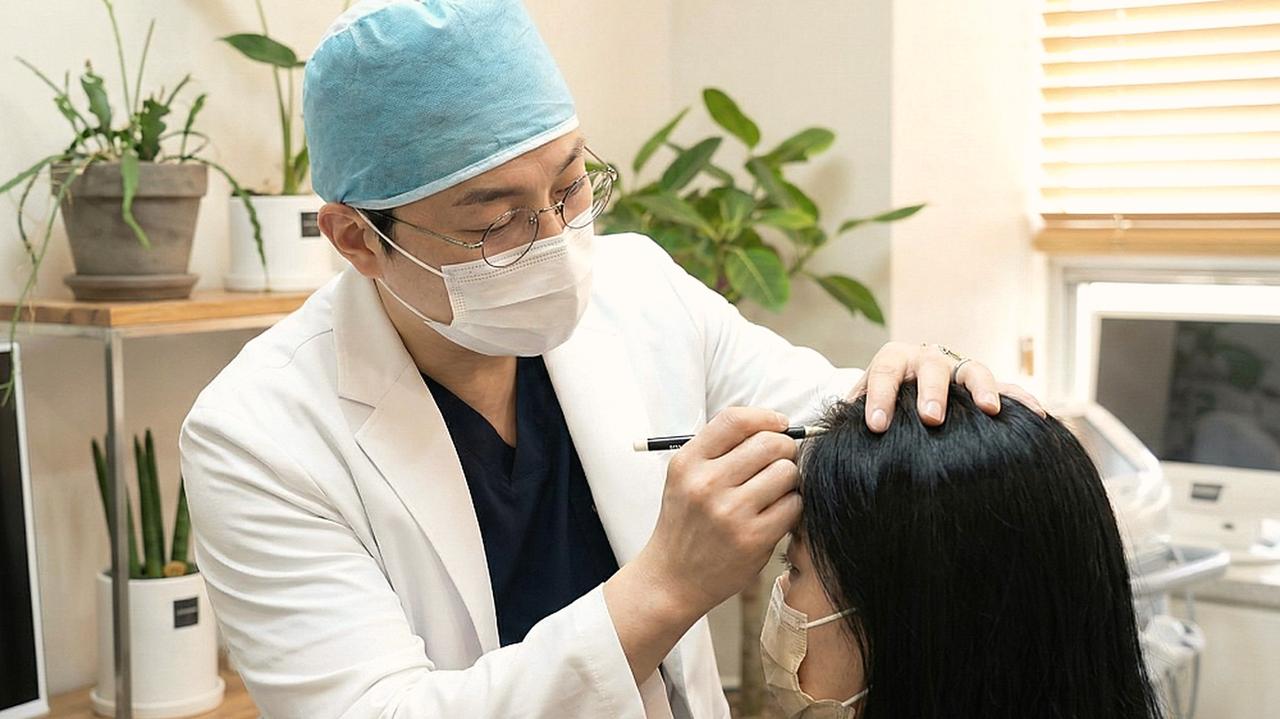
We look at the state of the scalp first, then decide the direction of treatment.
When it itches and flakes
It may be seborrheic dermatitis or folliculitis. If red bumps appear on the scalp, come in and we will decide the direction of treatment.
When the scalp is oily
Excess sebum burdens the follicles. Scalp botox regulates how much sweat and sebum comes out.
When surgery still feels like too much
If your hair has only thinned, medication and nutritional support alone can manage it. We do not push surgery on everyone.
When surgery is coming up
Before surgery we treat scalp inflammation and run blood work. Come in one to two weeks before the surgery date.
We choose by the state of the scalp
More often than not we combine two or three rather than using just one.

Scalp condition care
We treat seborrheic dermatitis, folliculitis, and scalp inflammation. If you have heavy dandruff, an itchy scalp, or red bumps, we examine it first and then decide the direction of treatment.

Scalp botox
It relaxes tense scalp muscles to improve blood flow and regulates how much sweat and sebum comes out. Repeating it about every three months works well.

PDRN
Derived from salmon, it calms a sensitised scalp and repairs damaged tissue. Repeating it about every two weeks builds up the scalp's own resilience.

Exosomes
Sending a growth signal to dormant follicles. Exosomes, which carry messages between cells, deliver growth signals straight to the follicle, improving the scalp environment and prompting a regenerative response in the hair.

Triamcinolone
Settling acute inflammation quickly. A small dose rapidly calms the excessive immune and inflammatory response in the scalp that causes sudden or patchy hair loss.

Scalp MTS
Opening a path for active ingredients. Fine needles stimulate the scalp to prompt its natural recovery signals and create channels so actives such as PDRN and exosomes are absorbed deeply.

Arche
Natural chitosan drawn from mushrooms forms a thin protective film on the scalp. Its small particles seep deep into the follicle, restoring the damaged barrier and settling inflammation.
Straight back to your day, no downtime
Scalp treatments do not require a separate recovery period.
There is no downtime
Because it is a scalp treatment, there is no separate rest period. You can go straight back to your day.
Please avoid these on the day
On the day of treatment, please avoid saunas, exercise that makes you sweat, and alcohol.
We finish with low-level laser
For aftercare we provide low-level laser treatment.
The interval matters more than a single session
We suggest scalp botox every three months and PDRN every two weeks. Results vary from person to person.
On hair loss medication and its causes
Nobody in my family has hair loss, so why am I losing hair in my early twenties?
Having no family members with hair loss does not mean there is no genetic predisposition at all. Hair loss genes can lie dormant and then switch on suddenly when they meet environmental factors such as stress, lack of sleep, or lowered immunity.
So unless there is no hair loss at all across relatives within eight degrees of kinship, it is likely that external triggers have activated the genes.
My hair has thinned a lot as menopause approaches. Is hair loss really linked to it?
Yes. Hair loss and menopause are closely linked through hormonal change. In women, oestrogen falls at menopause while the relative share of androgens rises, and as DHT gains influence a genetic tendency to hair loss can stand out more.
Men, by contrast, produce less androgen as they age, so hair loss tends to slow somewhat. Menopause is an important period in which the hormonal balance shifts and a latent pattern of hair loss can newly appear or change.
Can diffuse thinning across the whole scalp improve too?
Diffuse hair loss presents differently from typical male pattern hair loss, so medication alone may not deliver the effect you hope for.
In that case it works better to keep medication as the base and add booster treatments that promote growth. There are several options: scalp botox, PRP, stem cell treatments such as exosomes, growth factor formulations, and scalp inflammation control. What matters is that the doctor identifies the cause accurately and supplies the nutrition and stimulation that suit your situation, and with that, real improvement is achievable.
What side effects come with hair loss medication?
Side effects of hair loss medication can appear as the drug suppresses DHT, the hormone that interferes with hair growth. Statistically the rate is low, around 2%, but in practice more people than that notice fatigue or reduced sexual function.
Side effects do not automatically mean you must stop. If you work with your doctor to fine-tune the dose and interval and find the right amount for your body, you can keep treating while keeping the discomfort to a minimum.
I want to switch from finasteride to dutasteride. Should I worry about side effects?
Analyses pooling several studies suggest the rate of side effects does not differ greatly between the two drugs. If that still concerns you, dutasteride has a half-life of about four to five weeks, so its effect lasts a long time. For that reason treatment is sometimes planned as two or three doses a week rather than daily, depending on the patient.
A recent study observed that dutasteride 0.5mg taken three times a week gave hair improvement similar to or greater than 1mg of finasteride daily. With hair loss medication it is important to adjust how it is taken according to the extent of loss, age, individual response, and any side effects. It is best to decide the plan that suits you through consultation with a specialist.
Are topical and oral minoxidil equally effective?
Topical and oral minoxidil are both treatments that promote hair growth, but they are not easy to compare on equal terms. Topical minoxidil varies in effect with how often and how much you apply, and oral minoxidil likewise varies with the dose taken.
A recent randomised trial reported that taking 5mg of oral minoxidil once a day and applying 5% topical minoxidil twice a day gave a similar overall improvement in hair. At the crown, however, oral minoxidil tended to show a greater increase in terminal hairs. So in treating hair loss it is important to choose the method with the site and extent of loss, the patient's daily routine, and their response to the drug all taken into account.
We are planning a pregnancy. Is it safe for my husband to keep taking hair loss medication?
To answer directly: the chance of hair loss medication taken by a man affecting a partner or foetus through semen or saliva is extremely remote, so you can rest easy.
That said, depending on individual sperm motility and general health, the safest route is a tailored plan agreed with a specialist, adjusting the type of medication (finasteride and so on) or pausing it temporarily. Jarada considers not only surgical results but your family plans, and works out the healthiest way to take medication with you.

Let us look at your scalp first
Whether it is an itchy, oily scalp or hair that has already thinned, we have to see it to know. Book a visit, or ask our AI first.